Digital Printing vs. Offset Printing: Which One Is Right for Your Project?
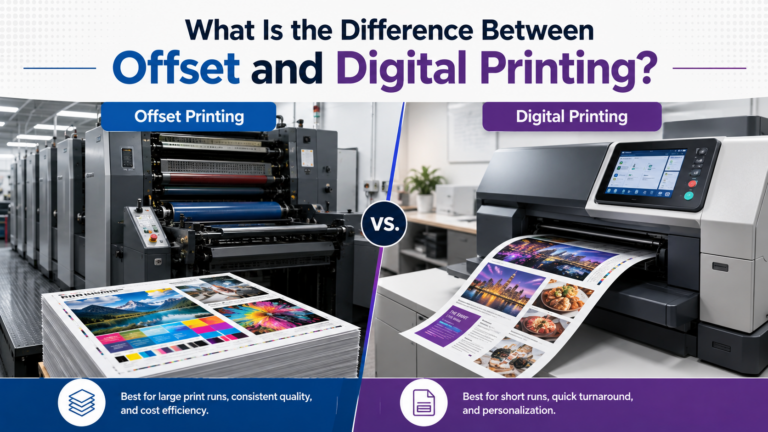
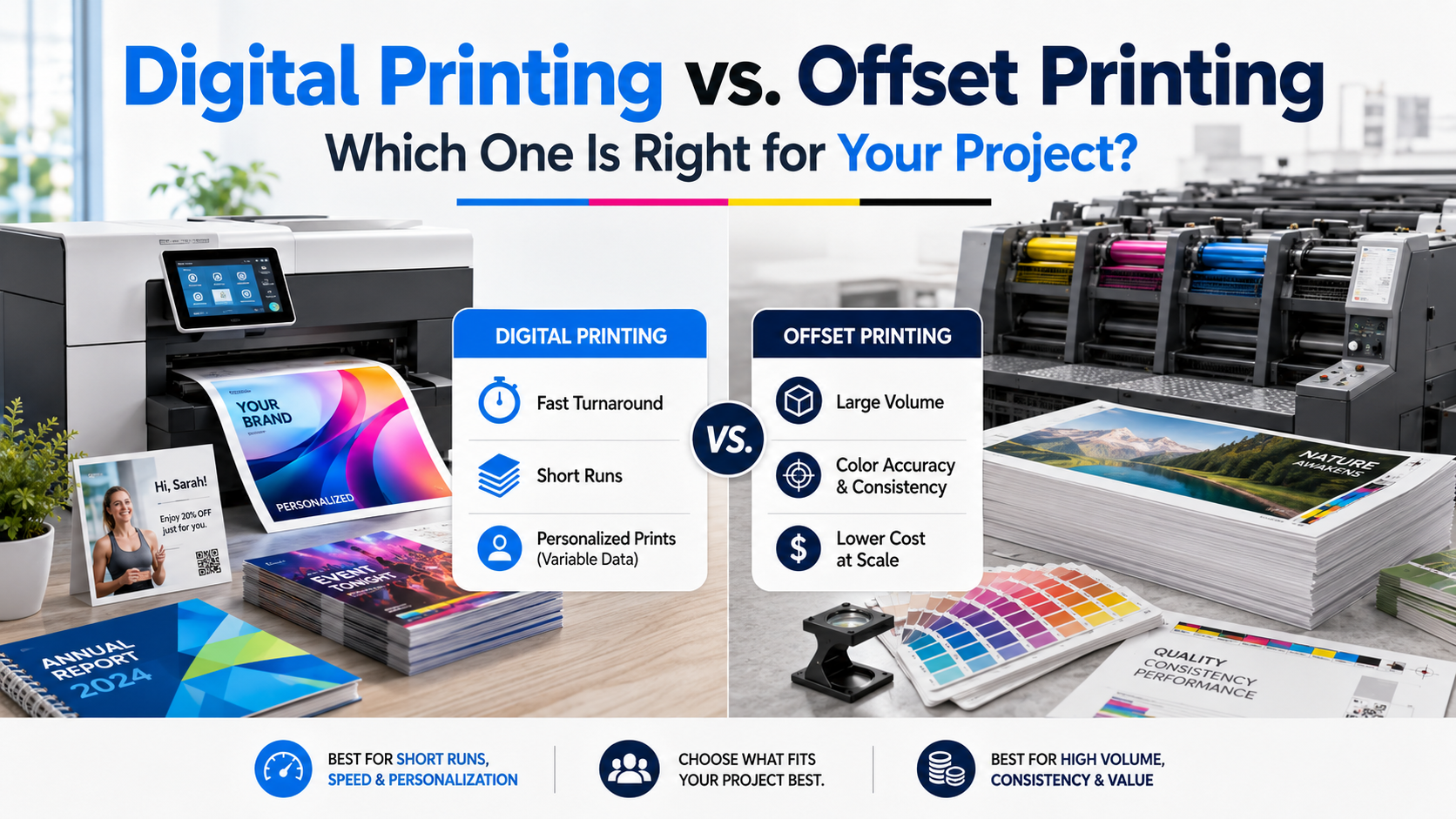
Direct Answer: Digital Printing is better for short-run printing (under 500 units), variable data printing, and projects requiring fast turnaround time (24-48 hours). Offset Printing delivers superior print quality for long-run printing (over 1,000 units), offers a lower cost per unit, and provides better color accuracy for large-scale printing. The break-even point typically occurs at 500-1,000 copies, depending on project specifications.
Digital Printing vs Offset Printing: Complete Comparison Chart

| Feature | Digital Printing | Offset Printing |
|---|---|---|
| Best Print Volume | 1-500 copies | 1,000+ copies |
| Setup Cost | $0-$50 | $200-$1,000 |
| Cost Per Unit (1,000 copies) | $0.50-$2.00 | $0.15-$0.50 |
| Turnaround Time | 24-48 hours | 5-10 business days |
| Print Quality (DPI) | 600-1200 DPI | 2400-4800 DPI |
| Color Accuracy | Good (RGB/CMYK) | Excellent (Pantone matching) |
| Personalization Capability | Yes (variable data) | No |
| Paper Stock Options | Limited | Extensive |
What Is Digital Printing and How Does It Work?
Digital Printing transfers images directly from digital files to paper using inkjet printer or laser printer technology without requiring printing plates. According to Smithers Pira (2024), digital printing accounts for 18.7% of commercial printing services worldwide. This printing method uses toner or liquid ink applied through electrostatic charges or droplet spray mechanisms.
The print production workflow for digital printing involves three steps: file preparation, color management through CMYK or RGB color gamut, and direct output to substrate. Unlike lithography-based methods, digital printing eliminates printing plate making and printing press setup, reducing both setup fees and printing turnaround time. Modern digital presses achieve resolution between 600-1200 DPI, sufficient for most marketing materials including business cards, flyers, and brochures.
Key advantages of this printing technology include print-on-demand capabilities, personalization through variable data printing, and economical printing for small batch printing. Print service providers can execute short run printing without minimum quantity requirements, making digital printing ideal for startups and small business applications requiring quick printing services.
Digital Printing Technology Types
- Inkjet Printing: Sprays microscopic ink droplets onto substrate; excellent for large format printing including posters and banners
- Laser Printing: Uses electrostatic charges and toner; superior for text-heavy documents and high volume printing under 500 units
- LED Printing: Similar to laser but uses LED arrays; offers consistent color reproduction accuracy across print runs
What Is Offset Printing and How Does the Process Work?
Offset Printing, also called lithography, transfers ink from printing plates to rubber blankets, then onto paper stock through a printing press. This commercial printing method originated in 1875 and remains the industry standard for high-quality printing and mass printing applications. According to the Printing Industries of America (2023), offset printing produces 65% of all commercial print output globally.
The printing process comparison shows offset printing requires extensive setup: creating printing plates ($50-$200 per plate), press calibration for registration and bleed specifications, and color matching using Pantone systems. A commercial printer typically needs 3-5 days for printing press setup before actual production begins. However, once configured, offset presses achieve printing production speed exceeding 15,000 impressions per hour.
Offset printing delivers superior print quality metrics including resolution up to 2400-4800 DPI, minimal dot gain, and exceptional color consistency across bulk printing solutions. The method supports extensive printing substrate options including coated/uncoated paper, cardstock, vinyl, and specialty materials. Professional printing services recommend offset for catalogs, booklets, and premium printing requiring color accuracy within 2% delta-E variation.
Offset Printing Press Technology Components
- Plate Cylinder: Holds aluminum printing plates with image areas attracting ink
- Blanket Cylinder: Rubber-covered roller transferring ink to substrate
- Impression Cylinder: Presses paper against blanket for ink transfer
- Ink Rollers: Distribute CMYK inks evenly across plates
How Do Print Quality and Resolution Compare Between Methods?

Print quality differences between digital and offset printing stem from fundamental printing technology advances in ink application methods. Offset printing achieves 2400-4800 DPI resolution because lithography creates continuous tone images with minimal dot gain (10-15% compared to digital’s 20-25%). According to IDEAlliance (2024), offset printing maintains color matching accuracy within ±2 delta-E, whereas digital printing ranges ±5-8 delta-E without advanced color management.
Digital printing quality standards have improved significantly since 2020. Modern high-end digital presses produce output resolution of 1200-2400 DPI, closing the quality gap for most applications. However, offset printing retains advantages for photography and packaging requiring precise Pantone color reproduction. The printing output resolution affects text sharpness, image detail, and gradient smoothness—critical factors when comparing printing methods for professional applications.
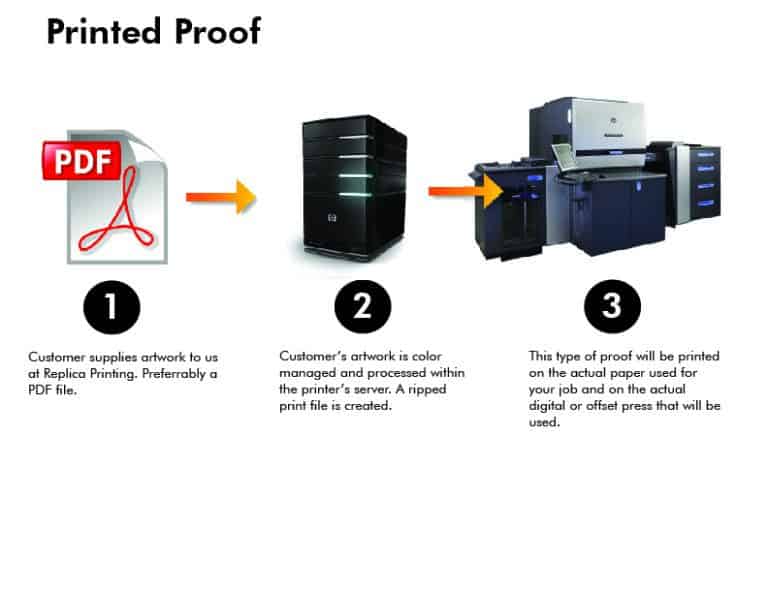
For business cards, brochures, and flyers under 500 units, digital printing provides acceptable print quality at lower total cost. For long run printing exceeding 1,000 copies, offset printing justifies higher setup costs through superior printing quality control and color consistency. Print shop services typically recommend reviewing printing proofing process samples before committing to large quantities.
What Are the Cost Differences Between Digital and Offset Printing?
Printing cost analysis reveals fundamentally different pricing structures. Digital printing has minimal setup cost ($0-$50) but higher cost per piece ($0.50-$2.00 per unit for standard 8.5×11″ four-color printing). In contrast, offset printing requires substantial setup fees ($200-$1,000 for plate making and press setup) but achieves cost per unit as low as $0.15-$0.50 for quantities exceeding 1,000 copies.
The break-even point—where total costs equal between methods—occurs at approximately 500-1,000 copies depending on print job specifications. According to Printing United Alliance (2024), a printing cost calculator shows:
- 100 business cards: Digital = $45, Offset = $350 (digital 87% cheaper)
- 500 brochures: Digital = $625, Offset = $550 (offset 12% cheaper)
- 5,000 catalogs: Digital = $6,250, Offset = $2,250 (offset 64% cheaper)
- 10,000 postcards: Digital = $12,500, Offset = $3,200 (offset 74% cheaper)
Hidden costs affect printing economics differently. Digital printing includes no waste charges but limited paper weight options (typically 60-130 lb). Offset printing allows extensive printing material options but requires overrun (5-10% extra) and minimum quantity commitments. Smart printing budget considerations evaluate total project investment including design, proofing, and printing finishing techniques like coating, binding, and trim size specifications.
How Does Turnaround Time Differ Between Printing Methods?
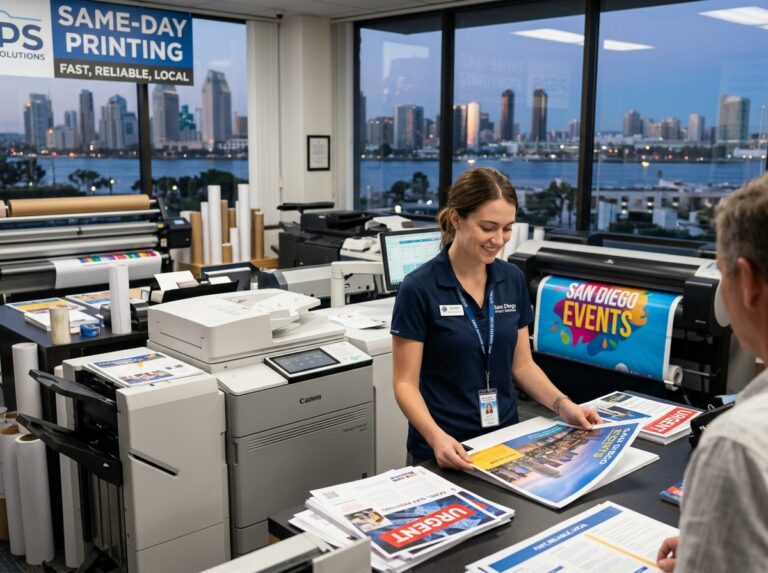
Printing turnaround time represents a critical printing decision factor for time-sensitive projects. Digital printing delivers finished products within 24-48 hours after file approval because printing equipment types like laser printers and inkjet printers require no plate preparation. Fast printing services using digital technology can produce small scale printing projects same-day for premium fees.
Offset printing requires 5-10 business days minimum: 2-3 days for printing plate making, 1-2 days for press setup and color calibration, and 2-5 days for actual production and finishing options. For urgent marketing materials or event-specific flyers, digital printing provides the only viable solution. However, for planned campaigns requiring bulk printing solutions, offset printing’s longer timeline rarely impacts printing deadline requirements.
According to research by the National Association for Printing Leadership (2023), 67% of print buyers prioritize printing turnaround over cost for runs under 250 units, whereas 82% prioritize cost for quantities exceeding 2,000 copies. This data supports the printing recommendation that project timeline directly influences optimal printing technology selection.
When Should You Choose Digital Printing Over Offset?
Choose digital printing for projects requiring:
- Low Volume Printing: Quantities under 500 units where setup costs make offset printing uneconomical
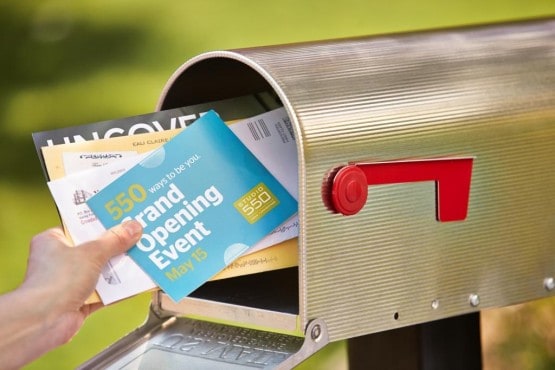
- Variable Data Printing: Personalized printing with changing text/images per piece (custom printing for direct mail)
- Quick Turnaround: Projects needing completion within 24-72 hours
- Print-on-Demand: Inventory-free production for books, marketing materials, or test campaigns
- Frequent Updates: Materials requiring regular content changes without plate remaking costs
- Budget Constraints: Limited upfront capital for printing investment where affordable printing matters more than per-unit economics
Digital printing best practices favor applications where personalization capabilities outweigh print quality considerations. For instance, variable business cards with individual names or sequential numbering on postcards require digital technology. Similarly, startups testing brochure designs benefit from small batch printing before committing to mass printing. The digital vs offset printing explained approach helps businesses match technology to specific needs.
When Should You Choose Offset Printing Over Digital?
Select offset printing for projects requiring:
- High Volume Printing: Quantities exceeding 1,000 units where lower cost per unit justifies setup investment
- Premium Print Quality: Photography, packaging, or branding materials demanding maximum resolution and color fidelity
- Pantone Color Matching: Corporate materials requiring exact brand color reproduction across print runs
- Specialty Substrates: Metallic paper, textured stock, or unconventional printing paper choices unavailable for digital
- Large Format Projects: Posters and banners exceeding 36″ where offset large format printing provides better economics
- Long-Term Consistency: Multi-year campaigns requiring identical color across reprints
Offset printing advantages include superior color gamut control, extensive finishing options (embossing, foil stamping, spot varnish), and better printing sustainability through vegetable-based inks. Large corporations and nonprofits executing annual campaigns typically choose offset for catalogs, booklets, and marketing collateral requiring printing industry standards compliance.
Real-World Use Case Scenarios: Choosing the Right Method
Scenario 1: Startup Marketing Materials
Project: 250 business cards, 200 flyers
Recommended Method: Digital Printing
Rationale: Low print volume (450 total pieces) makes digital printing 73% more cost-effective ($187 vs. $695 for offset). Quick printing services deliver within 48 hours, enabling rapid market testing. Variable data printing allows testing multiple designs simultaneously.
Scenario 2: Annual Corporate Catalog
Project: 10,000 catalogs (48 pages, saddle-stitch binding)
Recommended Method: Offset Printing
Rationale: High volume printing achieves $0.32 per unit with offset vs. $1.25 with digital—saving $9,300. Superior print quality ensures product photography accuracy. Pantone color matching maintains brand consistency across 10,000 copies.
Scenario 3: Event Promotion Campaign
Project: 1,000 posters (18×24″), needed in 3 days
Recommended Method: Digital Printing
Rationale: Despite quantity favoring offset economics, printing deadline requirements demand fast turnaround. Digital large format printing delivers within 72 hours vs. 10 days for offset. Cost differential ($1,200 vs. $850) worth premium for time-sensitive event.
Scenario 4: Direct Mail Personalization
Project: 5,000 personalized postcards with variable names/addresses
Recommended Method: Digital Printing
Rationale: Variable data printing capabilities unavailable with offset. Personalization increases response rates 29% according to Data & Marketing Association (2024). Digital’s $0.45 per unit justifies higher cost through improved printing ROI from targeting.
How Do Environmental and Sustainability Factors Compare?
Printing environmental impact varies by technology. Digital printing produces less waste because print-on-demand eliminates overruns, and no chemical plate processing occurs. However, toner cartridges create non-recyclable waste, and energy consumption runs 30% higher per impression than offset (EPA, 2023).
Offset printing uses vegetable-based or soy-based inks (85% of commercial printers since 2022) and aluminum printing plates that are 100% recyclable. The process generates chemical waste from plate development, though modern closed-loop systems reduce environmental harm by 60%. For printing sustainability, offset wins for large runs through better printing material optimization, whereas digital excels for small quantities by eliminating waste entirely.
Decision Framework: Choosing Between Digital and Offset Printing
Choose Digital Printing If:
- Quantity is under 500 units
- Turnaround needed within 48 hours
- Content requires personalization
- Testing multiple design variations
- No Pantone color matching required
- Budget limited for upfront costs
Choose Offset Printing If:
- Quantity exceeds 1,000 units
- Timeline allows 7-10 days
- Premium quality mandatory
- Exact color matching critical
- Specialty substrates needed
- Per-unit cost optimization priority
For printing consultation, most professional print service providers offer free printing cost calculators and sample comparisons. The optimal printing strategy often combines both methods: digital for prototypes and short runs, offset for proven designs at scale. Understanding these printing alternatives ensures printing optimization aligned with project goals, budget, and quality expectations.
Summary: Making the Right Printing Technology Choice
The digital printing vs offset printing decision hinges on print volume analysis, printing project requirements, and printing deadline considerations. Digital printing dominates the on-demand printing market for quantities under 500, delivering fast turnaround, economical setup, and customization. Offset printing maintains supremacy for batch printing exceeding 1,000 units through lower printing production costs, superior color management, and extensive substrate compatibility.
According to Smithers Pira forecasts (2024), digital printing will capture 25% of commercial printing by 2027, driven by e-commerce growth and demand for custom printing. However, offset printing will retain 60% market share for high-quality printing at scale. Smart printing vendor selection involves evaluating both printing method advantages against specific printing project planning criteria rather than assuming one technology universally superior.
For printing advice tailored to your specifications, consult printing expertise from certified print service providers who can demonstrate actual samples, provide accurate printing cost per piece calculations, and recommend optimal printing solutions balancing quality, speed, and budget. The printing knowledge required for optimal printing decision factors continues evolving as printing technology advances, making ongoing education essential for maximizing printing efficiency and print production value.